
Difference Between Cost Centre and Profit Centre with Example

Similarly, a country division is also treated as a profit center, as may a product line. For example, we will call the marketing department a cost center because the company invests heavily in marketing. Because the marketing function enables the sales division to generate profits. You won’t see a cost center and a profit center in a centralized company; since the company’s control is from a small team at the top. However, in a decentralized company where the power and the responsibility are shared, you will see cost and profit centers.
Cost center vs profit center vs investment center
Cost centers are responsible for managing and allocating costs related to their activities. The performance of a cost center is evaluated based on its ability to keep costs within budgeted limits while delivering the required services or support to other departments. Cost centers are often evaluated using key performance indicators (KPIs) such as cost variance, cost per unit, and cost efficiency ratios. Cost centers are typically responsible for managing costs, while profit centers are responsible for generating revenue. Therefore, a profit center may be better if the organization wants to hold managers accountable for revenue generation.
What is the main objective of a cost centre?
To measure the performance of a cost center, we need to do a variance analysis through which we would be able to see the difference between the standard cost and the actual cost. For example, the customer service facilities may not create direct profits for the company. Still, it helps control the company’s costs (by understanding what customers are struggling with) and facilitates in reducing the costs of the organization.
Difference Between Cost Centre and Profit Centre
On the other hand, profit centre is that section of the organization, in which the incurrence and recording of both costs and revenue are either by product or product line. Profit centers have the primary objective of maximizing software second look revenue and profitability. They are evaluated based on their ability to generate sales, increase market share, and achieve profit targets. Profit centers have their own revenue streams, cost structures, and profit margins.
- Keeping cost centers is important for long-term health and the organization’s perpetuity.
- Cost centers and profit centers are two different types of organizational units within a company.
- They provide valuable insights into the cost structure of an organization, enabling management to identify areas of inefficiency and take appropriate actions.
- This type of cost center would most likely be overseen by a project management team with a dedicated budget and timeline.
Similarly, if a profit center is not meeting revenue targets, managers can identify the causes and take steps to improve performance. It’s worth noting that even within the same company, different departments may operate as either cost or profit centers, depending on their function and objectives. The critical factor is whether the department minimizes costs or generates revenue. The primary objective of cost and profit centers is different, reflecting their distinct organizational roles. But cost centers incur costs to enable the profit centers to generate profits. Because managers take all the important decisions regarding product mix, promotion mix and technology used.
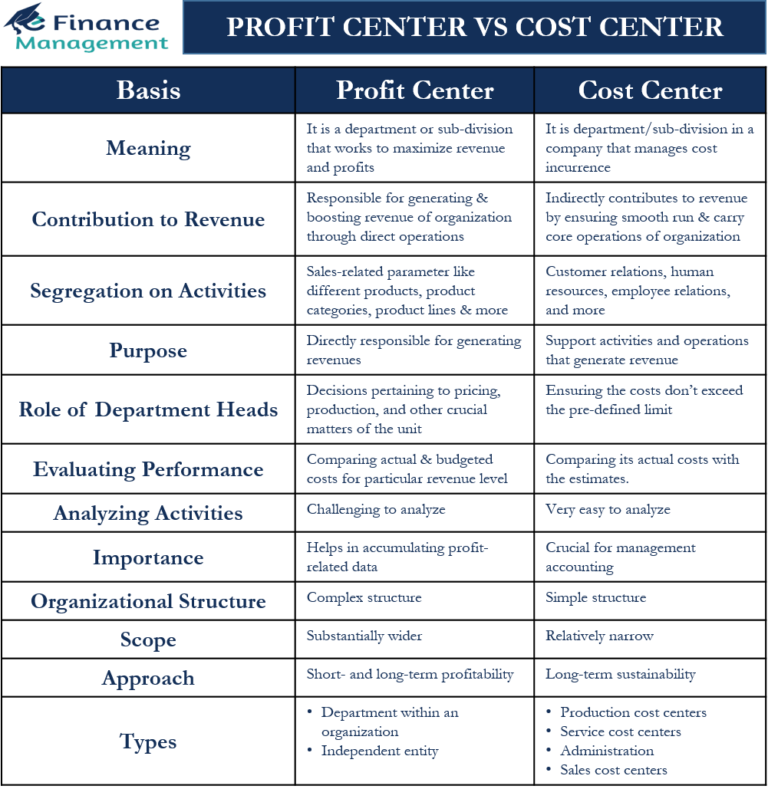
This narrow focus can lead to an incomplete picture of an organization’s financial health. For instance, think of all the ways a company can generate revenue by spending money; without some sort of view of revenue in association with costs, cost center performance can be misleading. In financial management, most companies will decide to assign expenses to specific departments, projects, or units within an organization. In contrast, profit centers typically have more resources allocated to them, as their primary objective is to generate revenue and profits for the company. Cost centers typically have limited decision-making authority, as their primary role is to cost-effectively provide support and services to other parts of the organization.
Cost centers do not directly generate revenue or profit for the company, but they are critical in ensuring it can operate efficiently and effectively. Examples of cost centers include administrative departments, such as human resources or finance, and support functions, such as IT, maintenance, and facilities management. Sometimes called an investment division, these units use capital to increase the company’s profits and are evaluated by the revenue they’re able to bring in. Unlike cost and profit centers, investment centers aren’t necessarily limited to activities directly related to the company’s central operation.
As opposed to the IT department above, a personal cost center would exclude physical materials. This type of cost center allows a company to isolate only the cost of headcount without being distorted by equipment, materials, or other goods. A cost center isn’t always an entire department; it can involve any function or business unit that needs to have its expenses tracked separately. Focus on customer satisfaction to ensure profit centers meet customers’ needs and expectations.
If the center has the potential to generate significant revenue, a profit center may be a better choice. However, if the center is unlikely to generate substantial revenue, a cost center may be more appropriate. As a result, the organization stops doing what doesn’t generate profits and starts doing more of what develops.